
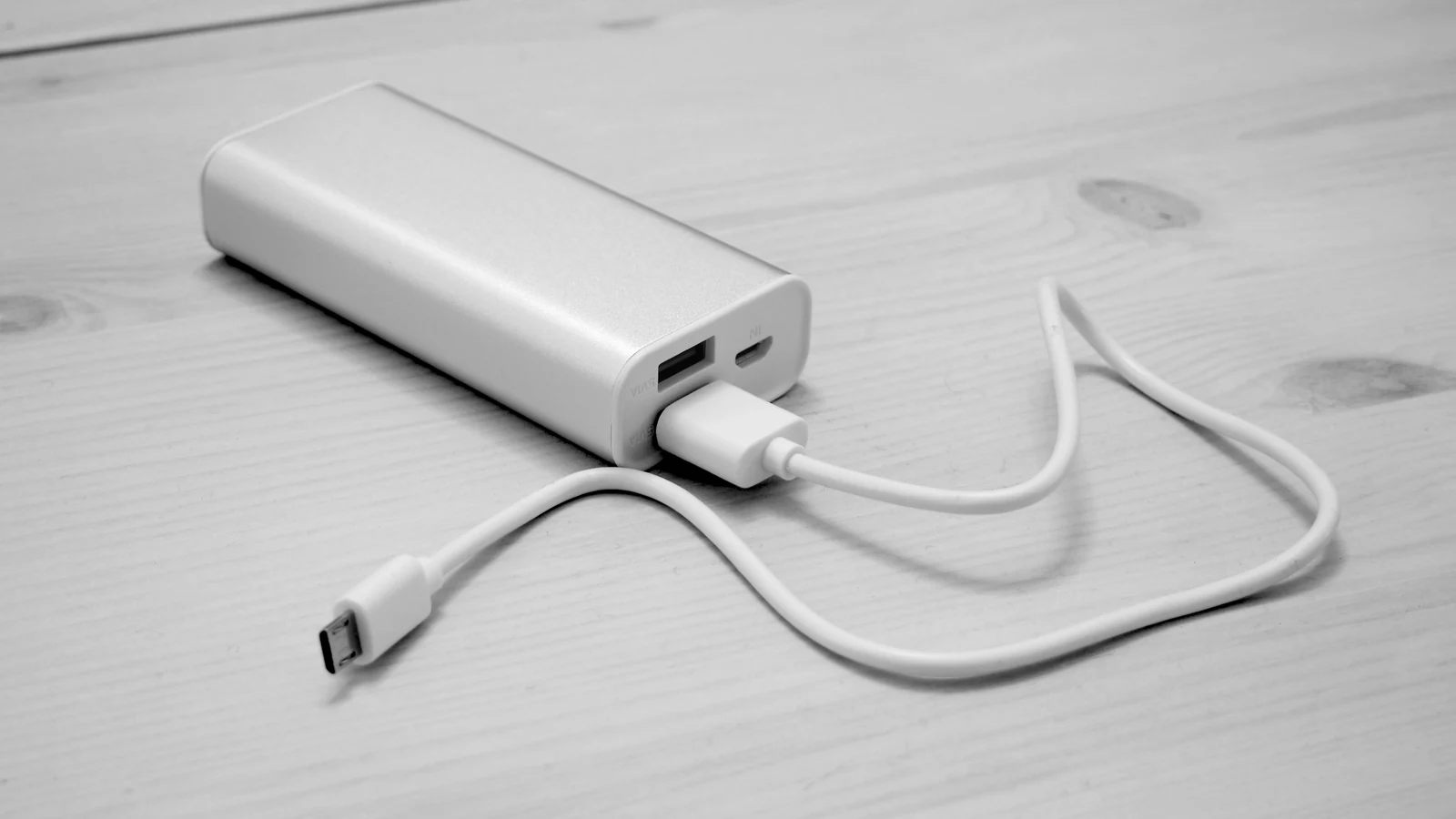
Before flying with a power bank, check its watt-hour rating, the number you can carry and your airline's rules for using it. A large mAh number on the box doesn't answer all three questions.
Keep power banks out of checked baggage, as IATA's 2026 guidance specifies. If your cabin bag is taken for gate-checking, remove them first. Then check every flight on your itinerary, not just the first airline's summary.
Start with the Wh label
The US Federal Aviation Administration's passenger guidance says lithium-ion batteries up to 100 Wh are generally allowed under its size rules. Batteries from 101 to 160 Wh require airline approval. These US thresholds are not automatic permission for a particular power bank on every international route.
The FAA gives this conversion: watt-hours equal amp-hours multiplied by voltage. To convert mAh to amp-hours, divide by one thousand. For illustration, a battery labelled 20,000 mAh at a nominal 3.7 V works out to 74 Wh.
Use the battery's nominal voltage, not whichever USB output voltage looks familiar. Prefer the manufacturer's clearly marked Wh rating; a calculation on your phone is not a substitute for a required readable label or airline acceptance.
Capacity is only one of the rules
In March 2026, ICAO announced new specifications limiting passengers to two power banks and prohibiting passengers from recharging the power banks during flight.
Implementation and operating restrictions still need checking for your route. For example, Singapore's aviation authority introduced a two-power-bank limit for departures from Singapore from 15 April 2026. It prohibits charging the banks onboard and advises passengers not to use them to charge devices during the flight.
CAAS also says airlines may have stricter policies. That is why an older packing guide mentioning capacity alone is not enough. For 2027 travel, check again: IATA's guidance says the allowance for power banks above 100 Wh will not carry into its 2027 dangerous-goods rules.
Carry, use and recharge are separate permissions
Ask three questions before departure: may I bring this power bank, may I use it to charge a phone, and may I plug it into the aircraft's power supply to refill it?
Permission to carry the device does not settle the other two. Follow the airline's current instructions and the crew's directions, including where it must be kept.
Our packing suggestion: keep the manufacturer's label visible and the relevant airline guidance easy to find. If a rule is unclear, ask the airline before travelling. Don't rely on the fact that security accepted the same device on a previous trip.
Check its condition before packing
The FAA warns against taking damaged or recalled batteries and tells passengers to alert cabin crew if a device overheats, expands, smokes or burns. Protect spare batteries from short circuits and keep them in cabin baggage as directed.
Do the condition check at home, where leaving a questionable device behind is easy. If something becomes hot or swollen during the flight, tell the crew rather than trying to hide it in your bag.
The useful preflight check is short: readable capacity, acceptable condition, permitted quantity and your airline's carry-and-use instructions. Enough charge for a phone is convenient. A device that meets the actual route's rules is what gets packed.

Reader Discussion