


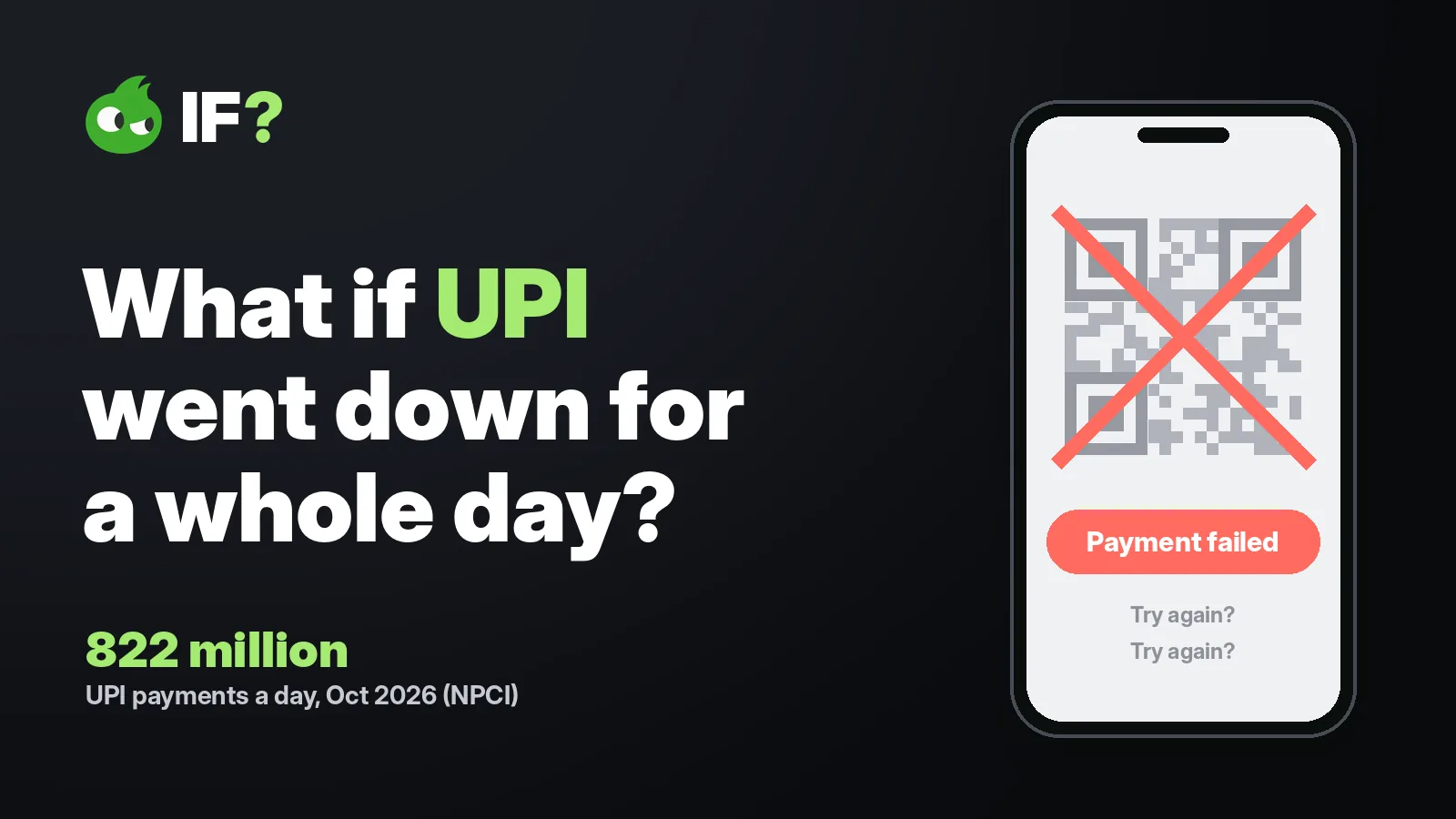
Picture a normal weekday. You scan the QR code at the chai stall, the screen spins, and then: payment failed. You try again. Failed. Your friend tries a different app. Failed. Now imagine that happening to everyone in India, all day.
UPI has become the way India pays for almost everything small. So what would a full day without it actually look like? We ran the numbers.
How big is UPI now?
Bigger than most people realise. In October 2026, UPI handled 25.47 billion transactions worth ₹31.53 lakh crore, according to NPCI data reported by the Free Press Journal. That works out to about 822 million payments every day, worth roughly ₹1.01 lakh crore.
Spread across 24 hours, that is what one lost day would put on hold:
| A day without UPI | Payments not made | Money not moved |
|---|---|---|
| Every second | about 9,500 | about ₹1.2 crore |
| Every minute | about 5.7 lakh | about ₹71 crore |
| Every hour | about 3.4 crore | about ₹4,200 crore |
| The whole day | about 82 crore | about ₹1 lakh crore |
Most of these payments are tiny. An SBI Research report, covered by Asianet Newsable, found that about 86% of person-to-merchant UPI payments are below ₹500. This is the money for milk, vegetables, autos and lunch, not big purchases.
What would the day look like, hour by hour?
This is a scenario, built from how people pay today and from what happened during real outages.
- 7 am: The first failures hit milk, newspapers and the chai stall. Vendors who only keep a QR code start asking for cash.
- 9 am: Commuters scramble at auto stands, fuel pumps and ticket counters. Anyone without cash is stuck.
- 11 am: ATM queues grow in every market. Small shops without card machines see sales collapse.
- 1 pm: Lunch orders and app payments shift to cards. Delivery riders who rely on instant payouts start to worry about the day's earnings.
- 6 pm: The evening rush is the worst. Grocery, dinner and travel all compete for the cash that is left in people's wallets.
- Midnight: Payments people postponed pile up for the next morning, when the system comes back under a wave of retries.
Has UPI actually gone down before?
Yes, but never for a whole day. In 2025 there were several nationwide disruptions. A UPI outage on 26 March lasted nearly three hours, and Swarajya reported that the outage on 12 April was the third significant disruption in a month. NPCI blamed "intermittent technical issues".
The 26 March outage showed up in the numbers. According to Business Standard, UPI processed about 550 million transactions that day, about 7% below March's daily average of 591 million. Even a few hours of trouble left a visible dent.
Is it really UPI that fails?
Here is the twist. In several outages, the central UPI switch kept working. The trouble was at individual banks. During the year-end disruption on 1 April 2025, NPCI said some banks faced intermittent declines while "UPI system is working fine". After an evening outage on 7 August 2025, NPCI again pointed to banks' internal technical problems, as Business Today reported.
That matters for you. If your bank is the one with a problem, a second UPI app linked to a different bank may still work. NPCI has also tightened rules to reduce load, such as capping balance checks at 50 a day from August 2025.
What still works when UPI stops?
Cash, first of all. India never actually went cashless. Currency in circulation hit a record ₹41.6 trillion in FY26, up 11.9%, the fastest growth since demonetisation, according to the same SBI Research report.
RBI Deputy Governor SC Murmu has said that cash remains important in rural and semi-urban areas, for low-income households, older people and small businesses, Outlook Money reported. In a UPI blackout, those are the people who would barely notice.
Debit and credit cards, net banking and bank transfers would keep working too. The real pain would fall on people who carry no cash and on small sellers who only accept QR payments.
Could a full day without UPI really happen?
It is very unlikely. Past outages lasted hours, not a day. Problems are often limited to certain banks, and NPCI has an obvious interest in keeping India's most-used payment system running. A short outage on a busy day is far more likely than a full blackout.
A few habits make even a short outage painless:
- Keep ₹500 to ₹1,000 in cash for emergencies.
- Link a second UPI app to a different bank account.
- Carry one debit or credit card.
- If a payment fails, check whether money left your account before you pay again.
- Small sellers: keep some change, and a card machine if your sales are large.
So would India survive a day without UPI? Yes, but it would be a very long, very cash-hungry day.
Would you? Tell us how long you could last without UPI.

Reader Discussion