


Cover illustration of the fictional cafeteria created with AI.
The tray has already hit the floor. You see a fork slide out from underneath it and spin on the cafeteria tiles. The person who dropped the tray stops, one hand still in the air. At your table, Mira lets out a little laugh, the startled kind that escapes before you can help it.
Then you hear the tray hit.
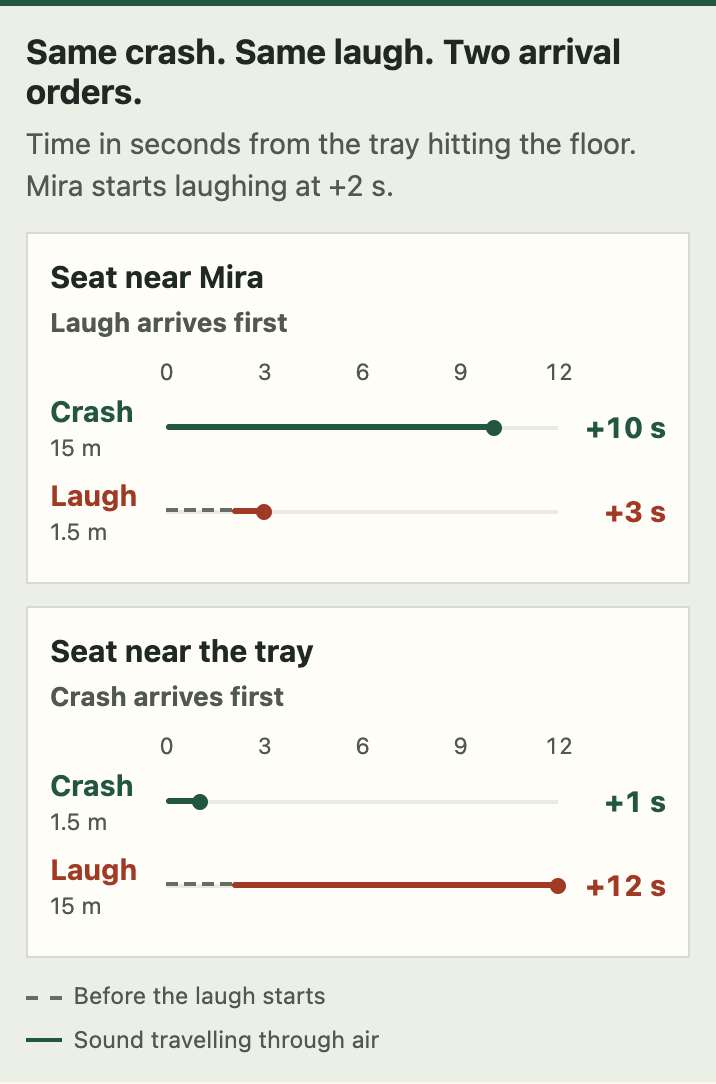
By now the person across the room has bent down for the fork. The crash you’re hearing belongs to a moment that’s already over. In this imagined cafeteria, sound travels through air at 1.5 metres per second, about as fast as someone walking briskly. The tray is fifteen metres away. Mira is a metre and a half away. Her laugh starts later and still beats the crash to your seat.
That reversal is the point of the thought experiment. Keep light and the sounds people make as they are. Slow only the journey of those sounds through the air, and follow the direct path to each seat. We’ll leave echoes and vibrations through the floor out of the scene.
The crash has a long way to go
On an ordinary day the gap between seeing the tray land and hearing it would be about four hundredths of a second at this distance. In air at 20°C, sound moves at roughly 343 metres per second. A much larger gap is easy to notice when lightning gives you a flash and the thunder arrives later. The room has a version of that delay already. We’ve made it long enough to watch. OpenStax’s speed-of-sound explanation · National Weather Service on thunder
Start a clock when the tray touches the tiles. The sound of the impact has fifteen metres to cross. At a metre and a half per second, that takes ten seconds. During those ten seconds, the light has already brought you the sight of the fall, then the fork, then the hand reaching down for it.
Mira starts laughing two seconds after the tray lands. Her laugh has only a metre and a half to travel. One second later, at +3 seconds on the same clock, you hear it. The tray’s crash still has seven seconds to go.
There’s room in that gap for a misunderstanding. If you glance up when you hear Mira, the tray is already lying on the floor. You might take the laugh for a reaction to something at your own table. Then the old crash turns up, and you have to put the afternoon back in order.
Change seats. Hear a different story.
Replay lunch from a seat a metre and a half from the tray. The person dropping it makes the same movement. Mira starts laughing at the same time. Only the paths to your ears have changed.
Here, the crash takes one second to reach you. You’ve already heard it when Mira starts laughing across the room. Her laugh travels fifteen metres in ten seconds, so it arrives at +12 seconds. From this chair the sound of the accident comes first, with a long pause before you hear the reaction.
Both people in the room could describe their lunch accurately. The person by the tray heard a crash followed by a laugh. The person sitting with Mira heard a laugh followed by a crash. If you want to know which sound started first, you need to know where each person was sitting.
There’s a seat where they meet
Now imagine choosing a chair somewhere between the two sound sources. Every step towards the tray shortens the path for the crash and lengthens the path for the laugh. Somewhere between the two seats, the head start from the falling tray and the extra distance it travels cancel out.
On a straight line between them, that spot is 9.75 metres from the tray and 6.75 metres from Mira. The crash travels for six and a half seconds. The laugh has a four-and-a-half-second journey and a two-second wait before it starts. Both sounds reach the listener six and a half seconds after the tray hits.
From that chair, the opening of the laugh could land on top of the crash. The laugh and the fall still happened two seconds apart. The distances have lined up their arrivals. Move a short way towards Mira and the laugh arrives first again.
A skydiver’s sonic boom
There’s a strange cousin of this scene in the account of Alan Eustace’s high-altitude jump. A crew on the ground reported hearing a boom. Jared Leidich, a member of the team, compared the time of their report with the jump’s tracking data. His analysis concluded that parts of the sound from later in the descent would have reached the ground before parts from earlier in the descent. Eustace was falling faster than his sound could travel. As he descended, he could make a new pressure wave much closer to the listeners than an older one. The boom itself went unrecorded, so that order comes from the team’s reconstruction. Jared Leidich’s account in Smithsonian Air & Space
Back at lunch, the tray and Mira are two separate sources. The same small piece of reasoning works for both stories. Whenever you hear something, its arrival time includes the trip from wherever it began.
Try asking for the salt
A little later, take opposite ends of a long table. There are three metres between you. You ask for the salt. Mira can see your mouth move while the first sound of the question is still making its way towards her.
At that distance, every part of the question arrives two seconds after you say it. Even if she starts replying as soon as she hears the end, it takes another two seconds for the start of the reply to get back to you. That’s four seconds of travel by itself, plus however long the words and any thinking take.
You might put your hand out before she answers. A visible gesture crosses the table on the timescale of light and can carry a simple request while the words are still in transit. You can picture an awkward version of lunch in which people discover that waiting a little longer to speak saves them from starting over each other.
The fork finally stops
Back in the first seat, the fork is already still when the crash reaches you. Mira has had time to glance back at her plate. The sound turns your head towards the tray just as the person across the room puts it back on the table.
Ask the person in the other chair what happened first. They remember a crash. You remember a laugh. The fork gives you both something to point to.
Reader Discussion