


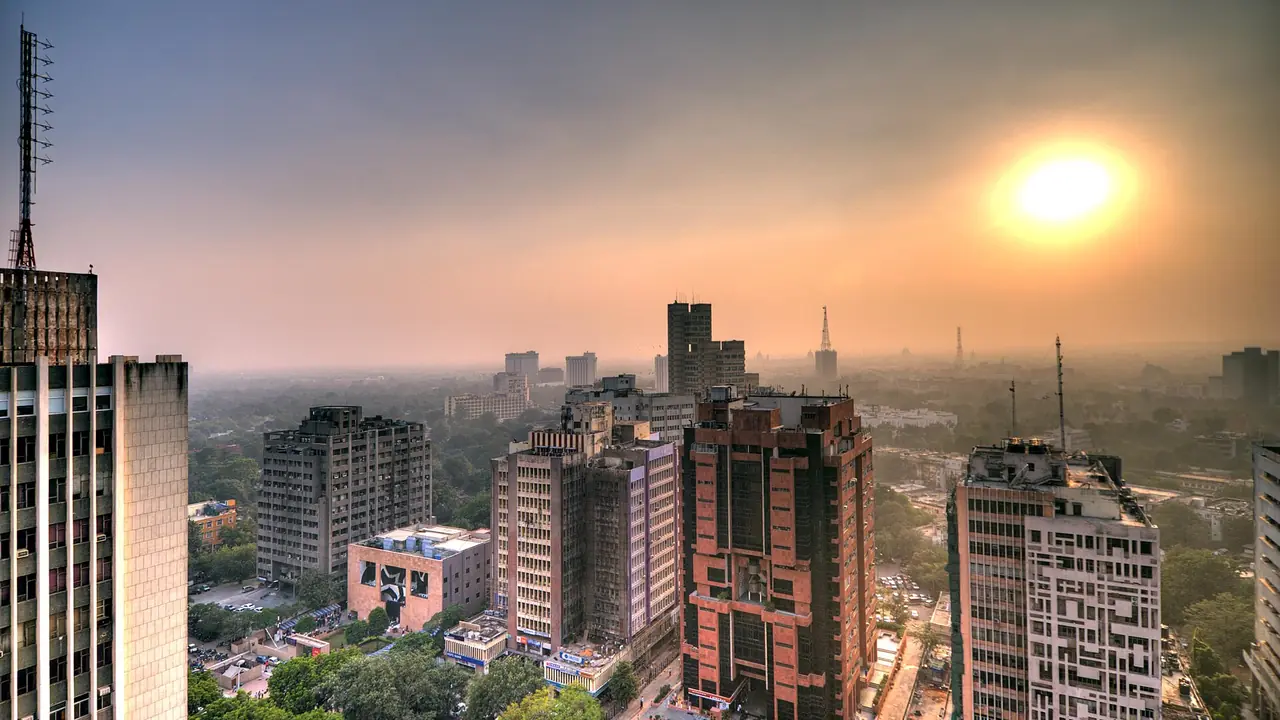
Every November, Delhi's mornings come with a number. This season it climbed from "poor" to "severe" in a week, and on November 8 the city's overall AQI hit 483. Knowing what that number means, and what you can do about it, is a practical skill in North India now.
Here is the scale, the rules that kick in at each level, and the steps that genuinely lower what you breathe.
Key Takeaways
- The AQI runs from 0 to 500; above 300 is "very poor" and above 400 is "severe"
- GRAP restrictions tighten in four stages as the AQI worsens
- This season, Stage II began on November 2 and Stage III days later, before Diwali
- A well-fitted N95 mask and closed windows with filtration cut exposure most
What do the AQI numbers mean?
India's Air Quality Index, published by the Central Pollution Control Board, sorts air into six bands: good (0 to 50), satisfactory (51 to 100), moderate (101 to 200), poor (201 to 300), very poor (301 to 400) and severe (401 to 500).
The number reflects the worst of several pollutants. In Delhi's winter that is usually PM2.5, particles small enough to travel deep into the lungs. City averages also hide local spikes: on November 6, monitors at IIT Delhi and Rohini both read 474, Open Magazine reported, while the city average sat lower.
What are the GRAP stages?
The Graded Response Action Plan is the rulebook the Commission for Air Quality Management applies across Delhi-NCR. As PTI explains, Stage II applies when the AQI enters the very poor band. Stage III follows in the severe range, and Stage IV, the strictest, is reserved for the worst episodes.
This season moved fast. Stage II was invoked on November 2 when the AQI reached 324, bringing higher parking fees and more road dust control. Stage III followed before Diwali, as readings at several stations crossed into the severe range. The ANI-reported reading of 483 came on November 8, per NewKerala, and the city stayed in the very poor range after, per Outlook Business.
How to protect yourself on bad air days
- Check the AQI for your nearest station, not just the city average, before planning time outdoors.
- Wear a well-fitted N95 or FFP2 mask outside. Cloth and surgical masks do little against fine particles.
- Move workouts indoors when the AQI is above 300. Hard breathing pulls in far more particles.
- Keep windows shut during morning and late-evening peaks, and run an air purifier in the room you sleep in.
- Take extra care with children, older adults and anyone with asthma or heart disease, and follow medical advice for existing conditions.
None of these steps fix the air. That depends on stubble fires, vehicles, construction dust and winter weather, which is why the GRAP stages exist.
But personal steps do change your daily dose. On a severe morning, the difference between a fitted N95 and nothing is the difference you can control.
Cover photo: wili hybrid, via Wikimedia Commons (CC BY-SA 3.0).


Reader Discussion