


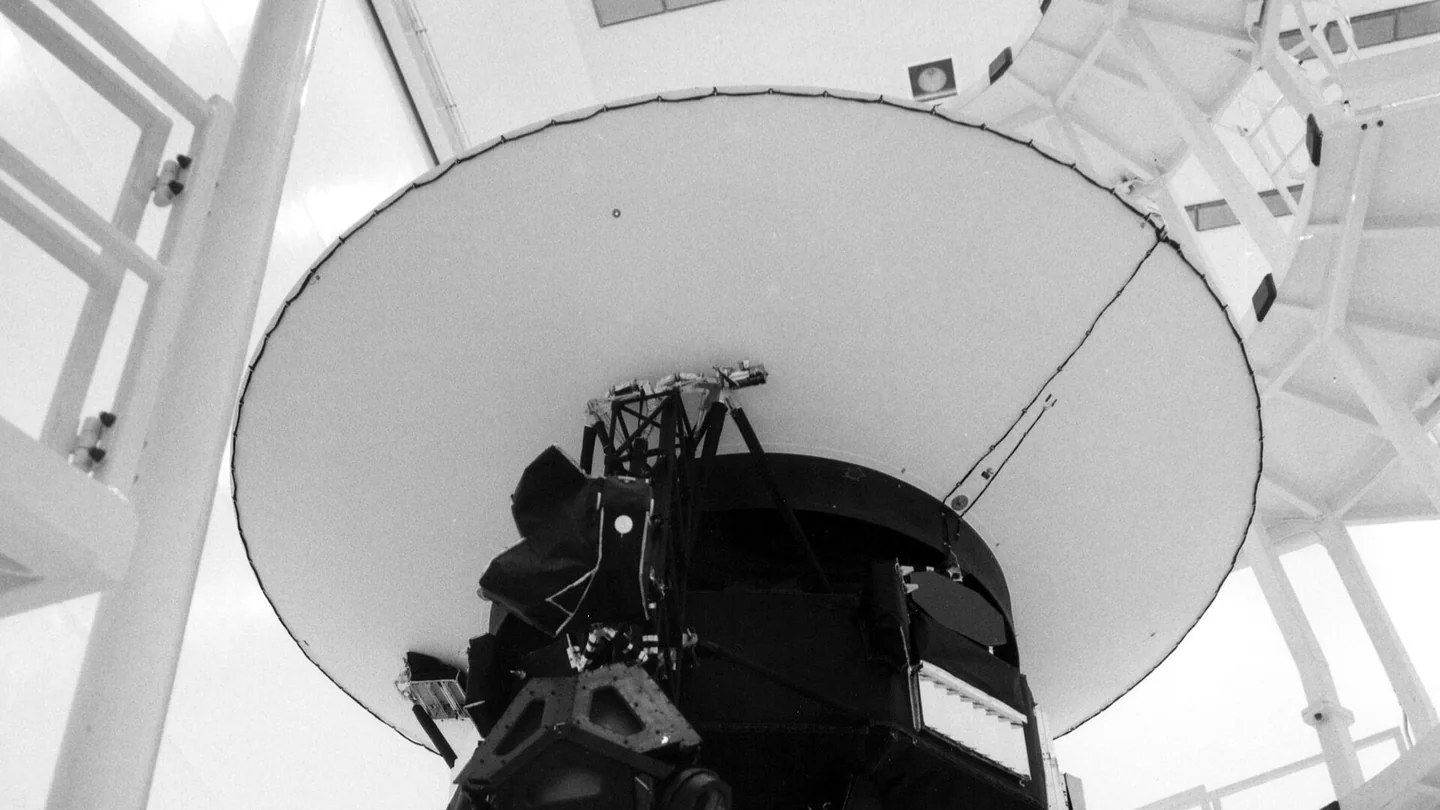
Voyager 1 during prelaunch preparation at Kennedy Space Center, August 1977. Archive photograph. NASA / Kennedy Space Center; photographer not named · Public domain. 16:9 crop, resize and WebP conversion; metadata stripped.
Voyager 1 has reached a place no other spacecraft has: one light-day from Earth. But the news comes with an awkward distinction. NASA can detect the probe’s radio carrier while still missing the science and engineering data it normally carries.
The distance record is confirmed. The data problem remains unresolved in NASA’s November 19 update. Those statements can both be true.
NASA says the spacecraft crossed the threshold on November 18, 2026, at about 10:16 UTC. Its announcement the following day used the detected signal and trajectory calculations to confirm the milestone.
A light-day describes the message’s journey
One light-day is the distance light travels in 24 hours: roughly 25.9 billion kilometres, or 16.1 billion miles. Voyager did not cover that distance in a day. The spacecraft launched in 1977.
Radio waves are electromagnetic radiation, just like visible light. They cross the same enormous gap at the speed of light in a vacuum, as NASA’s explanation of the milestone describes.
That puts a hard limit on any conversation. A command takes about 24 hours to reach the probe. A reply needs about another 24 hours to travel back. That is roughly 48 hours of travel alone, before allowing for processing, tracking schedules or time spent working out the next move.
Send command
← ≈ 24 hours
Send reply
About 48 hours of round-trip signal travel. Processing and ground operations can add time. Illustration of the light-time, not a live tracker.
Think of asking someone a question and knowing the earliest answer is two days away. Now imagine that the answer is supposed to help you repair the machine sending it. The delay turns each diagnostic exchange into a substantial commitment.
Hearing the carrier is different from reading the data
On November 14, a Deep Space Network antenna in Canberra detected Voyager’s carrier but received no science or engineering data. The mission team’s November 18 account describes engineers investigating what had gone wrong.
The carrier is the radio signal used to convey information. Detecting it tells engineers something important about the link. It does not mean the information has arrived intact.
NASA says the carrier indicates that the spacecraft is keeping its antenna pointed towards Earth and that its broadcasting equipment is working. The missing data suggests a problem involving the onboard computer that collects and formats that information. That is a working lead, not a completed diagnosis.
Engineering data matters because it reports on the spacecraft itself. Losing it makes troubleshooting harder at precisely the moment the team needs to understand the fault.
The milestone happened before Earth could hear about it
Reuters reported the crossing on November 18 using NASA’s advance calculations and explained that confirmation would require about another day. NASA’s November 19 release supplied that later confirmation.
That sequence is the distance made visible in a news story: an event happens at the spacecraft, and Earth learns about it later. It is worth keeping the event date separate from the announcement date.
Voyager entered interstellar space in 2012, after crossing the heliopause, the boundary of the Sun’s protective bubble of particles and magnetic fields. The new light-day mark measures distance from Earth; it is not a second crossing of that boundary.
What would count as the next good update?
A report that usable data is returning would tell us something different from another detection of the carrier. A confirmed diagnosis and repair would be further steps again.
For now, the remarkable part is also the difficult part. NASA is working with a spacecraft nearly half a century into its journey, and even the simplest exchange has become a two-day round trip. The distance is real. So is the wait.
Sources & further reading
- NASA: milestone confirmation, November 19
- NASA mission blog: engineers analyse the data issue
- NASA: what a light-day means
- Reuters: the predicted crossing and the wait for confirmation
AI assistance was used in research and drafting. Sources are linked above so readers can check the evidence.



Reader Discussion