


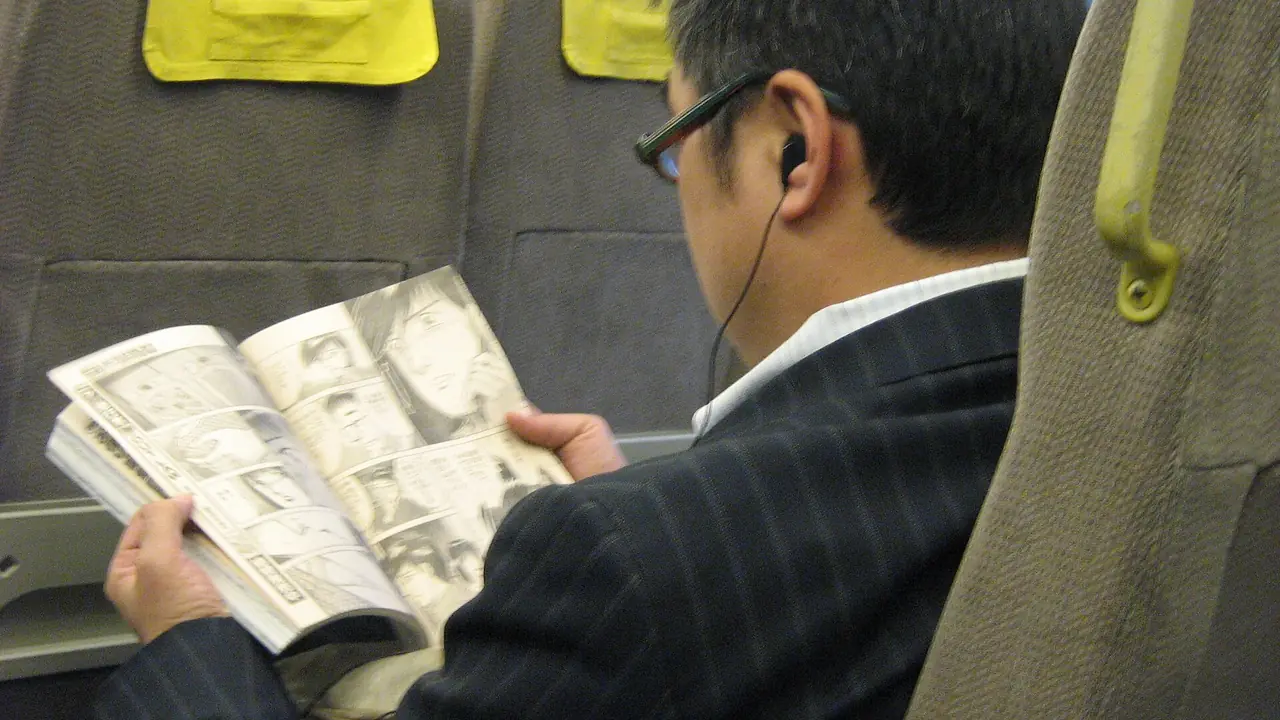
A manga reader on a train, photographed in an archive image. The panels illustrate the reading format; this is not an Apothecary Diaries edition comparison. Gavin Anderson. CC BY-SA 2.0. Cropped and converted to WebP.
The character looks familiar. The title is right. The cover says Volume 1. Then the book arrives, and the pages are mostly prose when you expected a comic.
A manga and a light novel can tell versions of the same story in different forms. Manga uses comic panels; a light novel is primarily prose, often with illustrations. Similar cover art does not make the books interchangeable.
The distinction is worth checking before you pay, especially when an anime has sent you looking for whatever comes next.
Look inside before judging the cover
Book Riot’s comparison distinguishes the reading forms and warns against assuming an adaptation is identical to its counterpart. That is the useful starting point, rather than deciding one format is automatically more serious or more complete.
Open the publisher’s sample. Are you looking at sequential panels and speech balloons, or paragraphs carrying most of the narration? A few illustrations inside a novel do not turn it into the manga edition.
Both can be sold as paperbacks. Both can have striking illustrated covers. A retailer’s broad “book” category therefore tells you less than the specific format label and actual pages.
One title can hide more than two choices
The Apothecary Diaries makes this particularly easy to see. Square Enix maintains a light-novel catalogue and a separate manga catalogue. The latter credits Nekokurage, with story development by Itsuki Nanao.
There is also VIZ’s Maomao’s Notes on the Inner Palace, an official manga adaptation with art by Minoji Kurata. That is another adaptation, not merely a replacement jacket for the Square Enix manga.
You do not need to memorise every credit. You do need enough information to recognise the version you intend to continue buying.
Volume numbers belong to their own editions
“Volume 3” means the third book in a particular publication sequence. It is not a promise that every adaptation reaches the same scene in its third volume.
Think of an adaptation as telling the story through another set of choices. Panels can make a glance carry a scene; prose can spend longer inside a character’s thoughts. That difference is part of the reading experience, not evidence that one version has been misprinted.
For the same reason, an anime episode number is not a reliable book-volume conversion. Use a guide specific to the adaptation and edition, with spoiler warnings, before trying to jump past material you have watched.
Save the identity of the edition, not just its thumbnail
Before ordering, record the full series title, format, language, publisher and volume number. The ISBN is useful for checking an exact book listing; the cover image alone is a weak identifier.
If a shop substitutes a different edition, revisit those details rather than assuming that matching the character and number is enough. For a digital purchase, check the preview in the format you expect to read.
For a gift, ask what the person already owns. “They like the anime” is a lovely reason to buy a book, but it does not tell you which version sits on their shelf.
Choose the experience you want
If you want to spend time with visual pacing and expressions, start by sampling the manga. If you want prose, sample the light novel. Neither choice obliges you to buy every adaptation.
The small print on the listing is doing useful work. Read it before the illustrated cover makes the choice for you.



Reader Discussion