

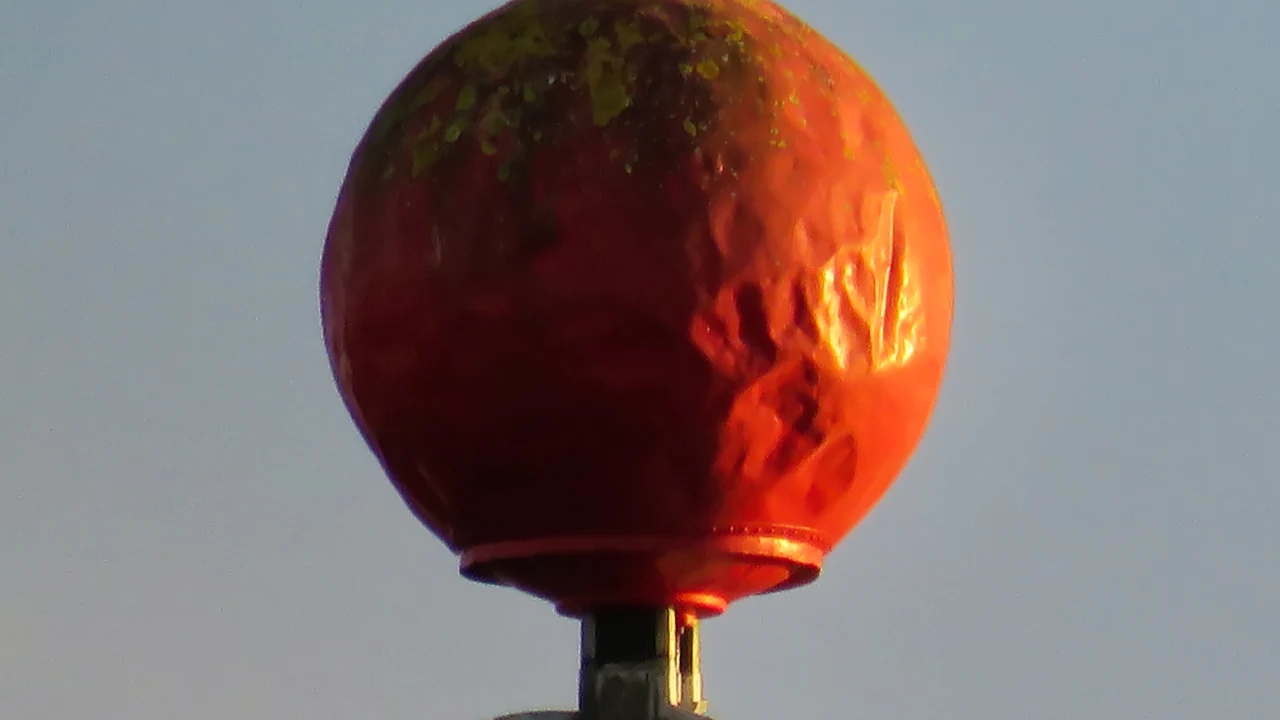
Picture the old routine. At five minutes to one, a red ball rises halfway up a mast in Greenwich. At two minutes to one, it reaches the top. A timekeeper aboard a ship on the Thames has a few minutes to get ready. At one, the ball begins to fall. The moment it moves is the signal.
The Greenwich Time Ball first gave that signal in 1833. It sits above Flamsteed House at the Royal Observatory. Royal Museums Greenwich gives the three times for its normal routine and says the ball is currently out of operation during restoration. The sequence is still a good way to understand how a harbour shared one precise instant before a radio could carry it.
What a navigator was checking
A marine chronometer carried reference time at sea. Compare that reference with local time determined from the Sun and you can work out longitude. A clock that gained or lost time could throw off that comparison. As New York’s South Street Seaport Museum explains, a ship could use a trusted signal in port to check the chronometer and keep track of its error.
The ball’s first rise said to get ready. Its second said the drop was close. A navigator needed a clear view of the mast for the final signal. Waiting for the ball to land would add however long it took to travel down the pole. The archive of the Greenwich time service traces how the observatory sent its time beyond the building and into the harbour.
Why a ball works from far away
Imagine standing on a deck and trying to read the hands of a clock on a distant roof. A large ball is easier to pick out, especially if you know where to look and get a few minutes’ warning. A visual signal also reaches nearby observers with essentially no wait on the scale that matters for a ship’s clock. Sound would arrive later for a ship farther away.
Today the shape looks like part of the skyline. Put yourself back on the river for the last two minutes of that routine and it becomes an instrument. Every ship that could see it could check its own clock against the same instant.
Cover photo: The Greenwich Time Ball above Flamsteed House at the Royal Observatory. Acabashi · CC BY-SA 4.0. Cropped and converted to WebP.


Reader Discussion