


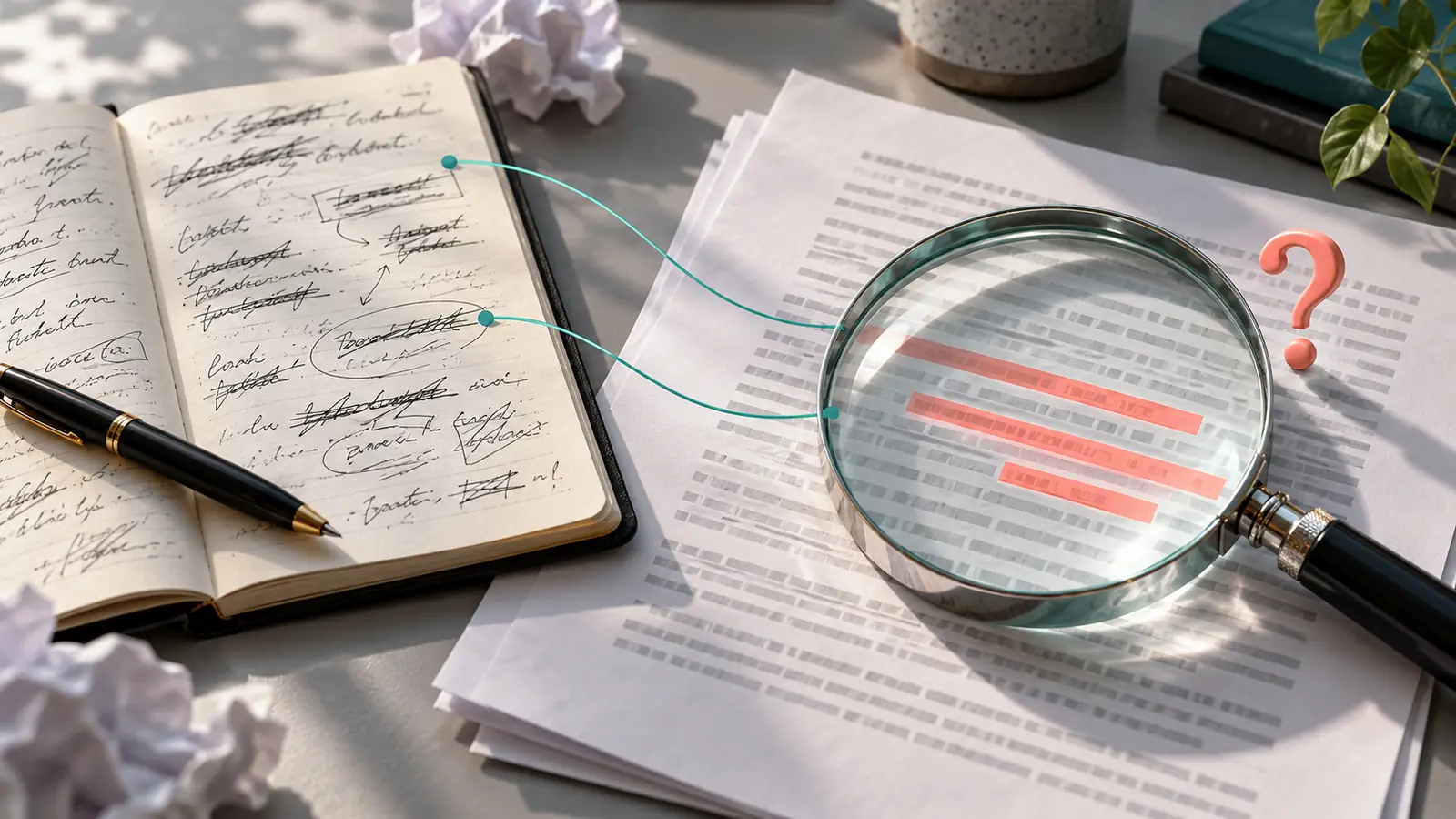
An AI detector has flagged your assignment. The coloured passages and percentage look precise, but they do not establish who wrote the text or whether a rule was broken.
AI detector false positives happen: human-written work can be flagged as generated text. Ask what the score measures, then look at the evidence around the work. Treating the number as a verdict skips both.
The percentage is not a probability of cheating
Turnitin's own guidance says its model can misidentify human-written and AI-generated text. It says the report should not be the sole basis for adverse action against a student.
Its percentage refers to qualifying text the model identifies as potentially AI-generated. The AI indicator is also separate from Turnitin's similarity score. A text match, a detected writing pattern and a breach of academic rules are different findings.
There is a fairness concern as well. Stanford's account of a 2023 study reported that the detectors examined frequently misclassified essays by non-native English writers. The research paper examines the consequences for evaluating those writers.
This was not a test of every detector available now. It cannot supply a current error rate for another product or model version. Our conclusion is narrower: a confident-looking label needs evidence around it.
If your work has been flagged
A practical first step is to keep the original submission and preserve genuine evidence of your process: notes, sources, earlier drafts and any existing version history. Do not manufacture earlier drafts to fill a gap in the record.
Ask for the specific concern:
- Which passages have been questioned?
- Which policy is said to apply?
- Is the issue prohibited generation, editing assistance, a citation problem or something else?
Explain how you developed the argument and used the sources. Be accurate about any assistance you did use. A tool may be permitted for one assignment and prohibited for another.
If a formal process has begun, use the institution's review or appeal procedure and keep the correspondence. This evidence may help explain your process; it does not guarantee an outcome.
If you are assessing someone else's work
The University of Melbourne's guidance requires evidence beyond a high detector score before an allegation. That is one institution's approach, not a universal rule.
A useful review starts with the work: check whether its sources exist, quotations are accurate and the writer can explain the reasoning. Invite an explanation of the questioned passage rather than treating polished grammar or unfamiliar phrasing as misconduct.
Writers should not have to damage clear prose to make it look more human. Deliberate errors and repeated rewrites aimed only at lowering a score do not make an argument better. The task is to resolve the actual concern, not to make the software display a more reassuring number.



Reader Discussion