


Set a stick upright in a sunny courtyard and mark the direction of its shadow at local noon. On an Earth that took exactly 25 hours to turn once against the stars, you could come back 25 hours later and still be early. You’d have about four more minutes to wait for noon.
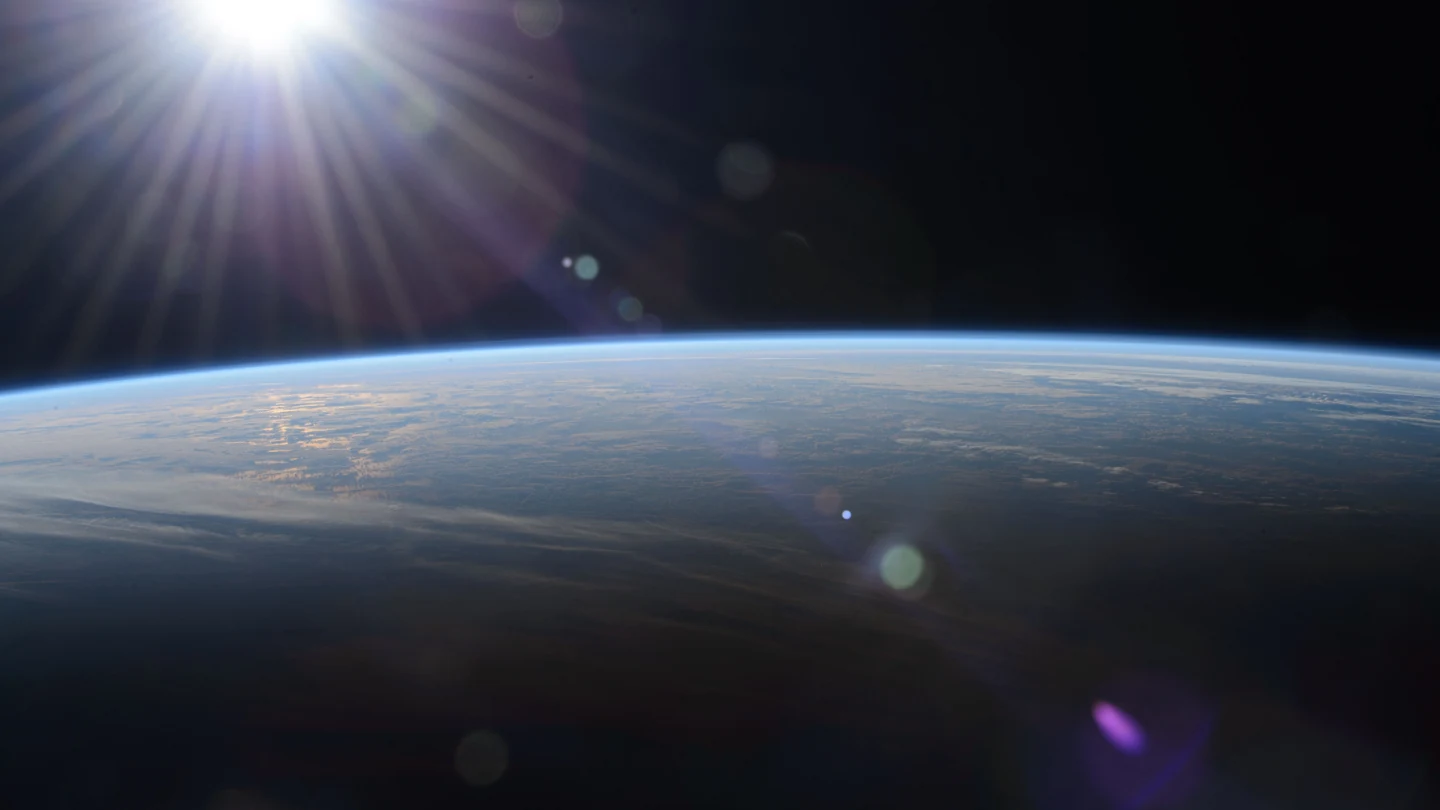
Cover photograph. Sunrise over the Pacific, photographed from the International Space Station on 3 January 2025. NASA Johnson Space Center, ISS072-E-424289. Public domain in the US. Cropped for this article.
For this thought experiment, let Earth slow down gradually. Keep its orbit and tilt as they are, and keep measuring an hour with the clocks we have today. We can then ask three separate questions. When would the Sun come back? What would the station clock say? And how many mornings would you get before your next birthday?
One turn leaves the Sun a little way ahead
Picture the stick again. While Earth turns beneath it, the whole courtyard is also travelling around the Sun. After one turn, the stick faces the same distant stars. From the courtyard, though, the direction of the Sun has shifted a little. Earth has to turn a bit farther before the shadow points along its noon line.
You already live with that difference. A turn measured against the stars takes about 23 hours and 56 minutes. The average interval from one solar noon to the next is 24 hours. Astronomers call the first a sidereal day. The second is the one that makes lunchtime feel familiar. Royal Belgian Institute for Space Aeronomy
Where would the extra daylight go?
It’s tempting to claim the whole extra hour for the evening. The night gets a share too. Imagine standing at the equator near an equinox, with a clear, level horizon. In a simple model that splits the solar day in half, you’d get roughly 12 hours and 32 minutes of daylight, followed by about as much darkness. That’s around half an hour more light than in the same idealised setting today.
Take the same experiment north in December and the split changes. Earth would still lean on its axis. A longer spin would give the existing winter arc of the Sun more time to play out. It wouldn’t lift the Sun higher in the sky.
What time would your train leave?
Imagine a station that keeps its familiar 24-hour clock. Today the Sun crosses the station meridian as the clock strikes twelve. Come back for the next solar noon and the clock would read about 1:04 PM. Riders catching the noon train would see the shadows at a different angle each day.
A railway could keep that clock and let daylight drift across its timetable. Or society could redesign civil time to follow the longer cycle. Keeping our current seconds and giving the dial room for a longer day is one choice. Dividing the longer day into 24 equal hours is another. Those new “hours” would each last about 62 minutes and 41 seconds by your old watch. Your watch could keep excellent time under either system. The argument would be over what to print on the timetable. NIST on Earth time and clock time
How many mornings until your birthday?
Keep a birthday tied to the same point in Earth’s orbit. The wait lasts just as long in seconds, but you’ll see about 350 sunrises at the equator along the way, down from about 365. A year still takes a year. You’ve simply put more time between mornings.
Here’s the arithmetic. One orbit lasts about 8,766 present-day hours. Divide by 25 and Earth makes about 350.64 turns relative to the stars. One of those turns is used up following the Sun around the sky over the full orbit. That leaves about 349.64 noon-to-noon intervals. Divide 8,766 hours by that number and you get about 25 hours, 4 minutes and 17 seconds per interval. That’s an average. An actual sundial varies over the year. NASA’s explanation of the extra turn
So if someone offers you an extra hour a day, ask which clock they mean. On this Earth you could linger over a sunset. You’d also have fewer sunsets to linger over.
Reader Discussion